The officials are the blind spot
A Turkish federation audit found 371 of 571 professional referees holding betting accounts. Most integrity programmes are still built for competitors.
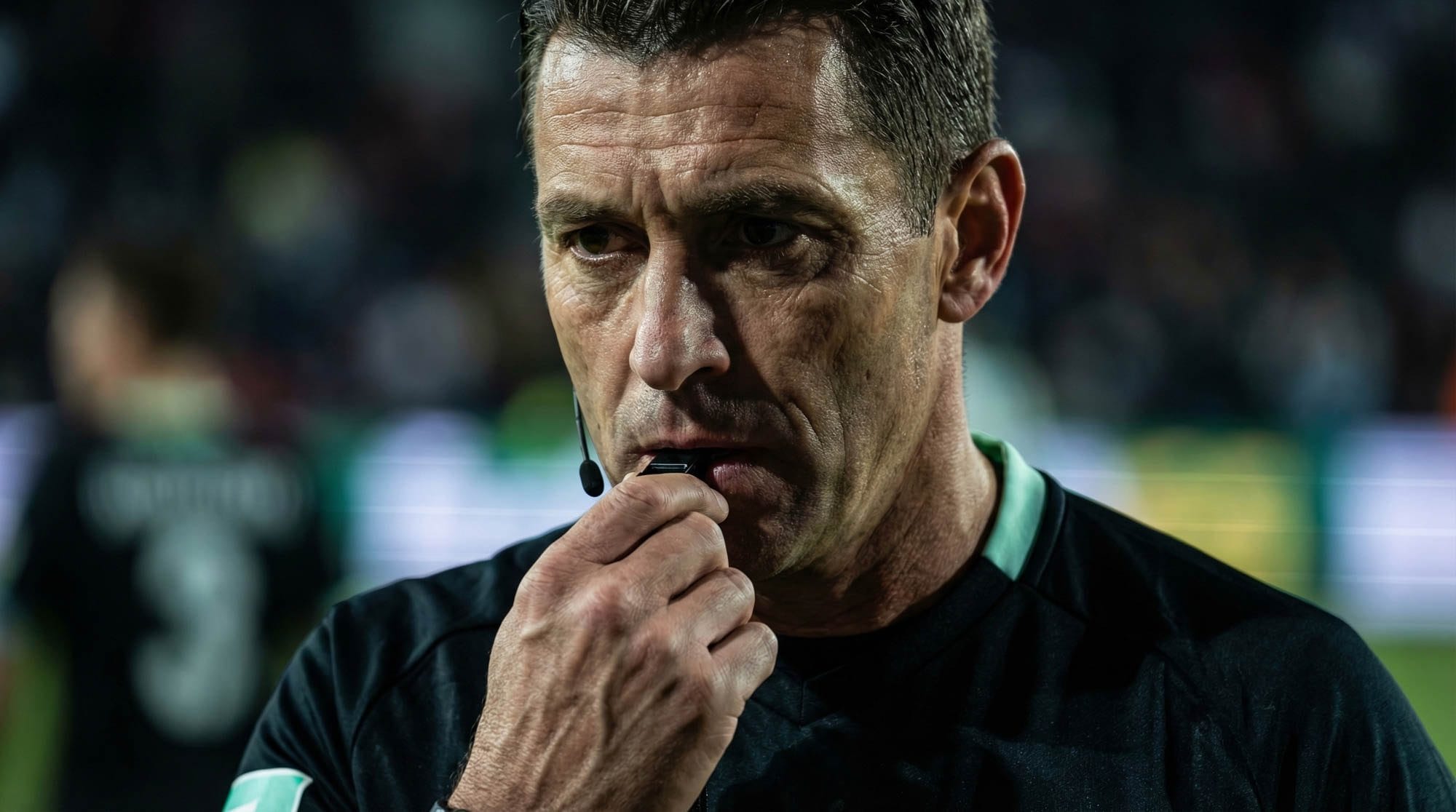
What an audit of referees found
The Turkish Football Federation audited the betting accounts of its active professional referees as part of a joint investigation with the Istanbul Chief Public Prosecutor's Office, opened on 27 October 2025. Of 571 active professional referees, 371 held betting accounts. Of those, 152 were actively gambling. One official had placed 18,227 wagers. Forty-two referees had bet on more than 1,000 matches each.
The federation suspended 149 referees and assistants for up to a year, and 1,024 players were suspended across the domestic leagues. Arrest warrants were issued for 21 people, 17 of them referees. During 2026 the case widened to club presidents, chairmen, coaches and executives.
There is no final criminal verdict in that investigation as of 9 September 2026, and the disciplinary suspensions are not criminal findings. What the audit establishes is narrower and still remarkable: nobody had looked. The accounts existed for years inside a professional refereeing body with a betting prohibition, and the scale only became visible when a prosecutor's office arrived.
Nobody had looked, because nobody had built the check
Integrity programmes across most sports were designed around competitors. Athletes get the induction session, the annual refresher, the app, the hotline number and the prohibited-betting rule. In 2025 Sportradar reported more than 34,000 athletes, officials and administrators through its education programmes, up 25% year on year, and that growth is real progress.
Monitoring has a comparable shape. It watches markets and it watches matches. When an anomaly appears, the question asked first is which players could have produced the observed outcome.
Match officials sit outside both designs, despite holding more direct control over more tradable events than any single player. A referee decides bookings, penalties, added time and, through the review process, whether a goal stands. Those are precisely the in-match events that now carry their own markets. At the 2026 World Cup, several of the seven yellow notices issued by the Group of Copenhagen concerned officiating decisions and disciplinary matters rather than results. A yellow notice is not a finding of manipulation, and no official at that tournament has been found to have done anything wrong. The pattern in the categories is still the useful signal: the market is trading the decision, not only the score.
Two bodies that closed the gap in 2026
Two governing bodies moved on this during 2026, and both used the same tool.
In January 2026 the PGA TOUR fully integrated IC360's ProhiBet into its integrity programme. In March 2026 the NCAA extended ProhiBet monitoring to match officials, covering more than 220 referees including alternates assigned to the men's and women's Division I basketball championships.
The mechanism matters, because it is not what people assume. ProhiBet is matching and identity technology, not an anomaly-detection model. It cross-references anonymised identifiers for prohibited bettors against sportsbook customer records, in encrypted form. It answers one question: is a person who is barred from betting on this competition holding an account with a licensed operator and using it. That is a different question from whether a market moved oddly, and it is the question the Turkish audit answered the hard way.
Why officials are harder, and why that is not an excuse
Three features of officiating make the check awkward, and each has a straightforward answer.
Officials are not employees of the competition. Many referees are contracted per appointment, or work for a national body that appoints them into competitions run by someone else. Prohibited-bettor checks and education duties therefore need to attach to the appointment, not to an employment contract. Whoever appoints an official is the party able to require the check.
Appointment data is sensitive. Fixture appointments are commercially and competitively sensitive, and are often circulated late for that reason. That is exactly why they are worth protecting as integrity data. The circle of people who know an appointment before it is public should be defined, logged and briefed, in the same way that team news is handled.
Officials are not offered money in the way players are. Approaches to officials tend to run through the people who assign, assess and promote them, which is a governance route rather than a dressing-room one. Education written for a 19 year old professional does not describe that risk. It has to be rewritten for the people whose careers depend on internal progression.
Personal data, and doing this lawfully
Extending monitoring to named individuals is a data protection exercise before it is a technology exercise. Where an AI system profiles named individuals, including officials, in ways that materially affect them, the high-risk analysis under the EU AI Act and its documentation, human-oversight, data-governance and logging duties apply. Regulation (EU) 2026/1744, the Digital Omnibus on AI published on 24 July 2026, deferred the application date for stand-alone Annex III systems to 2 December 2027, but left the substantive requirements unchanged.
There is also no sector-specific published guidance, from the Council of Europe, the Macolin bodies, IBIA, ITIA or Sportradar, on the use of AI in competition-manipulation detection or in the risk scoring of individuals. Any body extending monitoring to its officials is writing that policy for itself, and should write it down: what is checked, by whom, on what legal basis, with what retention period, and with what route for an official to contest a result.
What to do next
For anyone responsible for a competition, four questions are answerable this quarter.
Are your match officials inside the scope of your prohibited-bettor checks, or only inside the scope of your rule. Does your education programme have a module written for officials, addressed to their actual risk. Who holds appointment data, and how long before kick-off does it start circulating. If a market moved on a discretionary decision in one of your fixtures, would you have a record of who knew that decision was coming.
Watch two things over the next year. The first is whether the Turkish criminal process reaches a verdict, because that will shape how other federations treat their own audit obligations. The second is whether more governing bodies follow the NCAA and the PGA TOUR in putting officials inside the same monitoring perimeter as competitors. Until they do, the people who decide the events that markets trade are the least examined group in the sport.
Related reading
 Insight
AI moves fast, and so must the system around it
Machine flagging jumped in 2025 while total suspicious matches fell. That says something about sensitivity, and something harder about who carries the burden of proof.
 Insight
The approach came from a friend
Codes of conduct are written for a stranger with a proposition, and the approach that reached me came from someone I already trusted.
 Insight
The market moved from results to moments
In-play micro-markets let a participant shift a price without changing a score. Monitoring built around outcomes does not see that happen.