When a sanction moves, the market notices
A World Cup suspension was imposed and then suspended within days after political contact, with no published reasons and a market flag to follow.
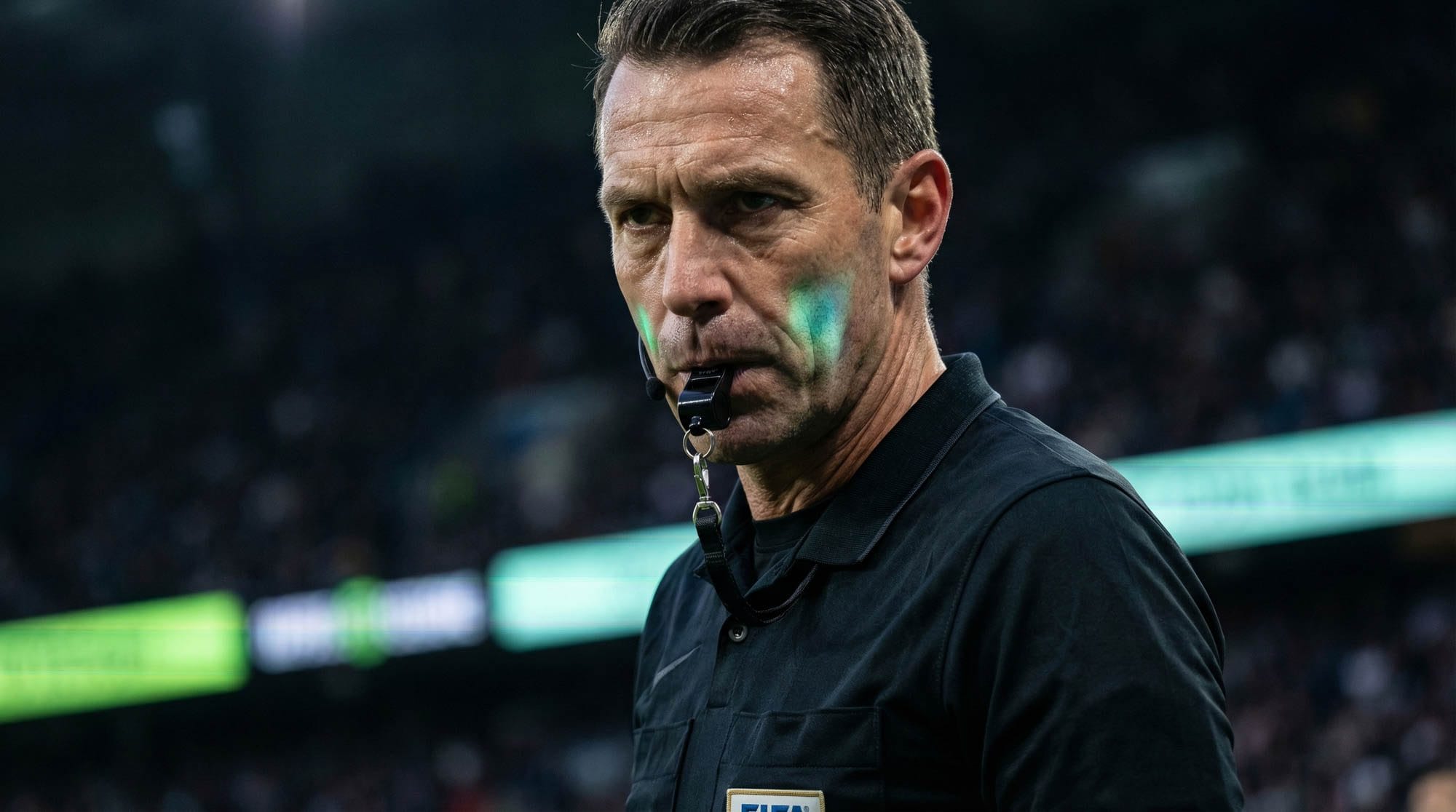
A decision, and then a different decision
In the Round of 32 of the World Cup a player was sent off for serious foul play. In early July 2026 the FIFA Disciplinary Committee found the offence proved. It imposed a one-match suspension, then suspended the implementation of that suspension for a one-year probationary period. It also imposed a fine of USD 40,000, for which the player's national association was jointly liable. An appeal by the opposing federation was ruled inadmissible.
Before the decision was reviewed, the President of the United States telephoned the FIFA President to ask for a review.
Reasons were not published.
UEFA said the decision crossed a red line, and described it as unprecedented, incomprehensible and unjustifiable.
We are not naming the player, and neither should anyone else in this context. He was sanctioned, and then the sanction was altered by the body that imposed it. Nothing about the sequence is his responsibility, and the integrity question here is institutional rather than personal.
Why this belongs in the betting integrity conversation
Sport tends to file this kind of episode under governance. Betting integrity gets filed separately, under monitoring, alerts and criminal conduct. The two files describe one subject, and this case is the clearest illustration of it in 2026.
A suspension is a market variable. Whether a named player takes part in the next fixture is priced, directly or indirectly. It is priced in team markets, in player-performance markets, and in the availability markets that exchanges and operators now offer. When a disciplinary body changes a suspension, it moves a price. When it changes a suspension without publishing reasons, it moves a price for reasons nobody outside the room can reconstruct.
The Council of Europe's published summary of the Group of Copenhagen's review of the tournament, released this week, records seven yellow notices across the 104 matches. The categories flagged in that review included certain referee decisions, the lifting of disciplinary sanctions, and unusual volumes on specific in-match events rather than on results.
A yellow notice is not a finding of manipulation. It denotes unexplained fluctuations in odds, rumours on social media, or source information, and it exists to open a question rather than to answer one. Three of the seven notices have never been described publicly, and the full review has not been published.
The information asymmetry is the exposure
Consider what existed in the days between the sending off and the final decision.
A defined set of people knew that a review had been requested. A smaller set knew what the committee was likely to do. Nobody outside that group knew either fact until the outcome was announced. Meanwhile a market existed on whether the player would appear in the next fixture.
That is a textbook insider-information problem, and sport does not usually treat it as one. Financial regulation has a name for material non-public information about a decision that moves a price, along with disclosure rules, restricted lists and a documented control framework. A disciplinary committee has minutes.
The comparison is not rhetorical. FIFA published a new edition of its Disciplinary Code, which entered into force on 1 May 2026. Disciplinary codes across the sport are built around the rights of the parties and the correctness of the outcome. Very few of them treat the decision itself as market-sensitive information requiring controlled disclosure. None of the participants in this case appears to have been under such a duty.
Two further data points from the same tournament
On 2 June 2026, nine days before the tournament began, two players selected for the World Cup were referred to authorities over suspected spot-fixing. The suspected incidents were in club matches, not World Cup matches, a distinction that has been repeatedly blurred. Both cases involved yellow-card markets, and bookmakers triggered the alerts.
Yellow cards are disciplinary events. The market that flagged those two referrals was a market on a disciplinary outcome, priced in play, on individual conduct. It is the same category of exposure as a suspension, at a smaller scale and a higher frequency.
The regulatory drafting has caught up faster than the sporting drafting. The Commodity Futures Trading Commission published a proposed framework for prediction markets on 12 June 2026. It would disallow contracts on officiating decisions and on injuries, while permitting contracts on final scores, results and statistical performance. A regulator, in other words, has already concluded that markets on discretionary decisions about individuals are a different and worse proposition than markets on results.
Sport has not reached that conclusion about its own decisions. Alain Berset, Secretary General of the Council of Europe, made a related point in remarks reported around the final. He argued that betting has moved away from the result of a match towards moments a single player can produce. He proposed an immediate working dialogue with FIFA, to build an integrity framework for the 2030 World Cup before it is played rather than after. Disciplinary outcomes are moments that a small number of officials produce.
The credibility cost, separately
FIFA's Integrity Task Force stated on 21 July 2026 that monitoring across all 104 matches identified no suspicious betting activity or indications of manipulation in connection with any fixture. That statement may well be correct on its own terms.
It is also being read alongside a decision that was altered after a call from a head of state, with no published reasoning. An organisation asking to be believed about market surveillance is asking for trust in its process, and it had just spent that trust elsewhere. Insurers, sponsors and broadcasters make exactly this connection, and they make it quickly.
What a governing body should do about this
Publish reasons for every disciplinary decision, and for every change to one. A published reason ends speculation and creates a record. Silence guarantees the opposite and costs the same amount of time.
Treat pending disciplinary decisions as market-sensitive information. Define who knows, from when, what they may not do with it, and how the outcome is released. This is standard practice in regulated markets and it is not difficult to copy.
Extend participant betting rules to the people who make the decisions. Officials, committee members, their staff and legal advisers hold the information that availability markets price. Most rulebooks are written about players.
Log external contact. Any approach from outside the organisation about a live disciplinary matter should be recorded, with who made it and what was asked. The record is the protection, for the body and for the individual.
Connect disciplinary and monitoring functions. If your monitoring provider is not told when a sanction is under review, it cannot interpret the market movement it is about to see.
What to watch
Whether the Group of Copenhagen's full review is published, and whether the remaining notices are described. Whether FIFA publishes any post-tournament account of its own assessment. And whether the Council of Europe dialogue on the 2030 tournament takes up disciplinary disclosure. It is the cheapest fix available, and the one nobody has committed to.
Sources
Related reading
 Insight
Two bodies, 104 matches, opposite conclusions
FIFA reported nothing suspicious across the World Cup. The Group of Copenhagen recorded seven yellow notices. Sport has no shared definition of the word.
 Insight
Seven flags at the World Cup: what independent integrity monitoring changed
The Copenhagen Group raised seven alerts at a World Cup that FIFA declared clean. The gap between the two accounts is the strongest case yet for independent, connected integrity systems.
 Insight
Prediction markets are sport's next regulatory flashpoint
The CFTC withdrew its event-contract rule, then a World Cup suspension became a tradable market. What regulators and federations should prepare for.